KH.21.O.460
Dublin Core
Title
KH.21.O.460
Description
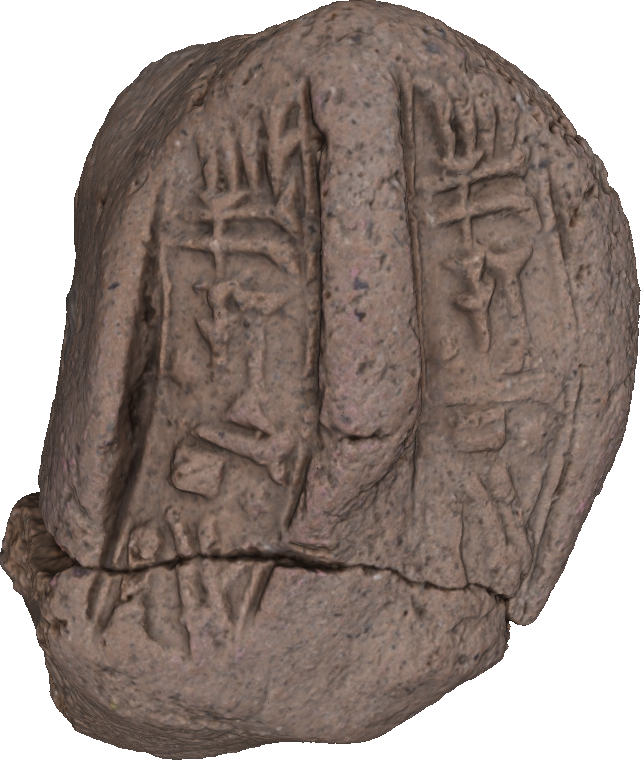
Complete hanging sealing, drop-shaped, with a pierced hole on the top for the string encased into the lump of clay, from the eastern room in the Seal-house. Hanging sealings (or bulla in literature), cone-, pyramid-, drop- and cylinder-shaped, are mainly known from Hittite contexts in Anatolia (see Cat. no. 26), secured to written documents by means of tiny strings (Herbordt 2005: 33-34, fig. 18.a-b; Waal 2023: 138-142). The sealing presents, on one side and the base, four impressions of the same signet ring bearing the owner’s name, Piradu, both in cuneiform and hieroglyphic writing, respectively [pi/pí]-ra-du and pi (L66)+ra/i (L383)-tu (L88), accompanied by his title, AULA (L254) “loyal (noble)man” and likely profession, MAGNUS?.X?. While the name Piradu, probably of Hurrian origin, is common in Middle Assyrian sources, it is possible that we are here dealing with the same person attested at Emar, if the Mutri-Teshub of two documents from that site (Beyer 2001: 136, B46, Msk 73.1019 and Arnaud 1986: 261, Msk 7441) is actually one and the same person, because in one Piradu is mentioned and in the other one Ewri-Teshub, a diviner whose seal is known both from Karkemish (with Sunaili and Zinni I; cf. Cat. nos. 1, 4 and see Peker 2023a: 128 no. 7, figs. 6-7) and Emar (Beyer 2001: 56-57, A14).
3D Model Item Type Metadata
3D Model
Site
Karkemish
Area
C East
Level
Phase B
Locus
F.11576
Context Type
"Seal House"
Context Date
Late Bronze IIB
Sealing Measures
l. 3.1; w. 2.1; th. 1.9 cm
Files
Collection
Citation
“KH.21.O.460,” OrientLab Digital Collections, accessed October 24, 2026, https://www.orientlab.net/digital_museum/items/show/1150.