KH.17.O.089
Dublin Core
Title
KH.17.O.089
Description
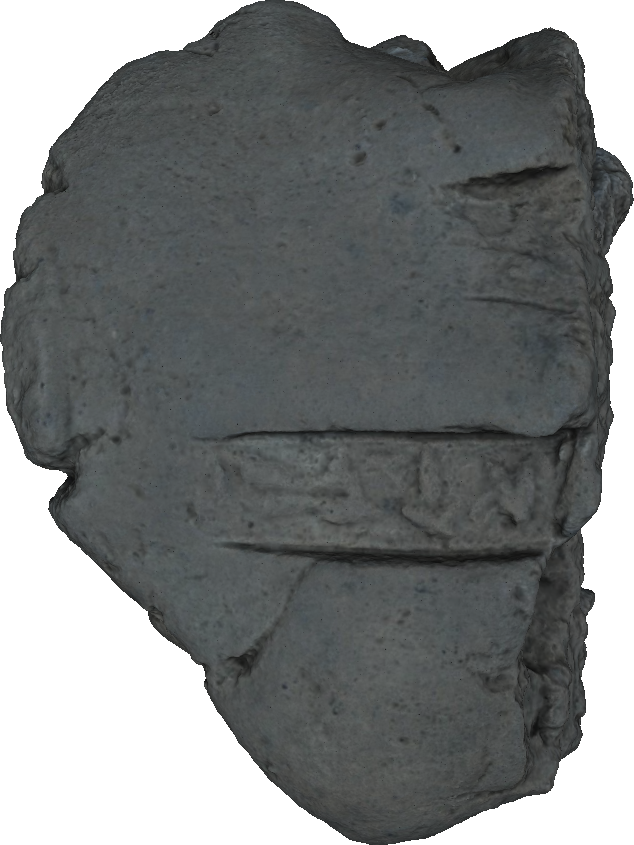
Because the sealing was found within the fill of an Iron II pit (P.8050) cutting into the Late Bronze IIB and Iron I layers, we cannot date it by stratigraphic means and it may well belong to an immediately post-Imperial phase. It was applied against the neck and rim of a juglet (diam. ca. 5 cm), probably markedly outturned, covered with a piece of fabric, perhaps an open weaved gauze made out of fine threads, bound with two rows of cord (0.2 cm diam.), the negative signs of which can be seen along the broken section of the sealing. On the obverse it bears two impressions of the same signet ring engraved with Anatolian hieroglyphs giving the owner’s name: i(a) (L209) – zi/a (L376) – tá (L29) which can be read as Iz(z)ita, a name hitherto not attested. This seal is distinct from other 13th century BCE signet ring examples (as Cat. nos. 2, 8, 10) and it may also date from a slightly later period having no decoration and a simple linear arrangement of the signs, thus its date can be broadly determined as between the late 13th and the mid-12th centuries BCE (in the latter case, being contemporary with Cat. nos. 24-30).
3D Model Item Type Metadata
3D Model
Site
Karkemish
Area
C East
Locus
F.8051
Context Date
Late Bronze II or Early Iron I
Sealing Measures
h. 3.6; w. 5.2; th. 2.4 cm
Files
Collection
Citation
“KH.17.O.089,” OrientLab Digital Collections, accessed October 24, 2026, https://www.orientlab.net/digital_museum/items/show/1139.